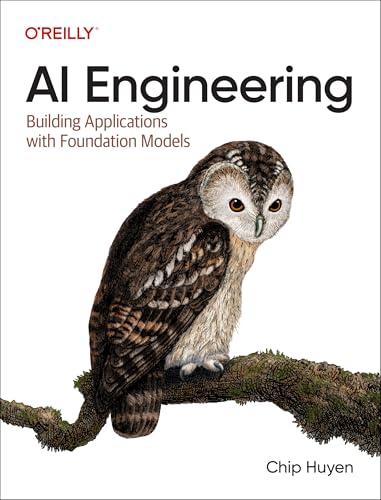
AI Engineering: Building Applications with Foundation Models
Recent breakthroughs in artificial intelligence have democratized access to powerful tools, enabling developers with minimal experience to build sophisticated applications using the model-as-a-service approach. In *AI Engineering*, author Chip Huyen explores this shift, defining AI engineering as the process of constructing applications with readily available foundation models. The book distinguishes this new discipline from traditional machine learning engineering and introduces the modern AI stack. It provides a comprehensive framework for development, guiding readers from simple techniques to advanced methods while addressing critical challenges such as latency, cost, and the potential for catastrophic failures. A significant portion of the text focuses on the practical aspects of navigating the complex AI landscape. Developers will learn how to select appropriate models, datasets, and evaluation benchmarks for their specific needs. Huyen discusses essential model adaptation techniques, including prompt engineering, Retrieval-Augmented Generation (RAG), fine-tuning, agents, and dataset engineering. Because the open-ended nature of these models increases the risk of errors, the book emphasizes rigorous evaluation strategies, such as the emerging AI-as-a-judge approach, to ensure reliability and performance in production environments. Written by a seasoned expert who has taught at Stanford and worked with industry leaders like NVIDIA and Snorkel AI, this guide serves as a vital resource for building efficient AI products. It builds upon Huyen’s previous bestseller, *Designing Machine Learning Systems*, offering complementary insights for the new era of generative AI. By examining bottlenecks in serving foundation models and offering solutions for deployment, the book equips AI application developers with the knowledge to transform theoretical capabilities into robust, real-world solutions.
About the Authors
Chip Huyen